
Reusable Exhibition Display Stands That Cut Event Waste
Teardown is often where an exhibition stand’s useful life ends. Panels get cut apart, printed boards go in the bin, and a frame that took days to assemble leaves the hall in pieces. Reusable exhibition display stands break that pattern by treating the structure as a long-term asset and the printed surface as the part you change. This guide covers how reuse works on a trade show floor, what to check before approving a design, and where the benefits stop.
Table of Contents
Exhibition Waste Reduction Starts With the Stand
In September 2020, UFI, the global association of the exhibition industry, released a report on waste in the sector. Its summary names exhibition stands as the most pressing common challenge, with materials, responsibilities, and costs all part of the problem. UFI released a report on waste management in the exhibitions industry.
The same release notes that waste regulations do not relate specifically to exhibitions and vary hugely by region, country, and even city. It also points to low awareness among exhibitors and visitors. That leaves a lot of the decision with the exhibitor at the briefing stage, long before the hall opens.
Two terms help here. Modular exhibition stands are built from standard frames and panels that can be rearranged into different footprints. Trade show display systems are the wider family, which includes portable systems, pop-up frames, banner stands, and kiosks. Both share one aim: build once and use repeatedly.
How Modular Layouts and Interchangeable Parts Work
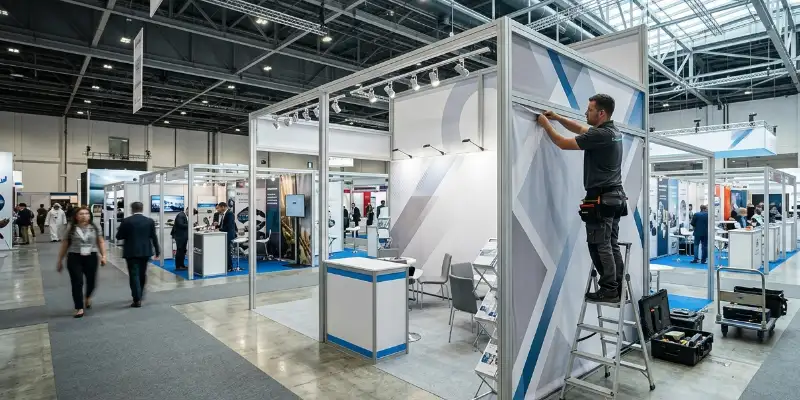
Picture a company that exhibits at GITEX in Dubai and then takes a smaller space at a regional fair a few months later. A one-off custom build gets scrapped and rebuilt. A modular frame can be reconfigured to the new footprint, with fresh graphics fitted to the same structure.
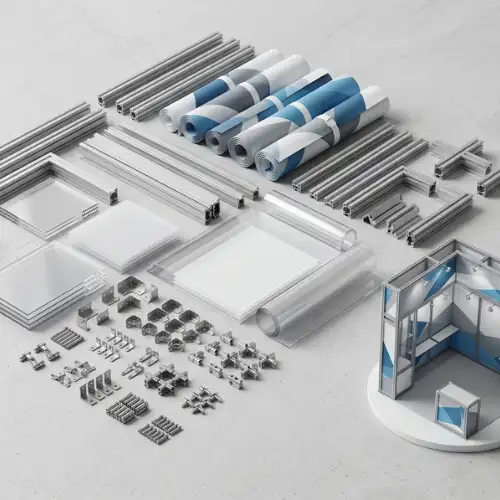
That flexibility depends on a few design features: modular layouts, interchangeable display elements, graphics customized for each event, and setup and dismantling quick enough to repeat without damaging parts. Space-efficient layouts matter too, since a stand that scales down to a compact footprint is easier to bring back than one fixed to a single size.
Reusable exhibition display stands work well when the frame outlasts the campaign. Branding changes more often than structure does, so keeping the two separate is a sound design decision.
Four Checks for Reusable Exhibition Display Stands
Start with materials. Hard-wearing options such as acrylic and stainless steel, plus UV-resistant inks on printed graphics, cope better with repeated handling and the UAE climate.
Look at how graphics attach. Printed panels or fabric can change per event while the frame stays, but ask how many swaps the fitting allows. Finishes vary too, from matte and gloss to UV coating and soft-touch, so ask which one is applied and how to care for it.
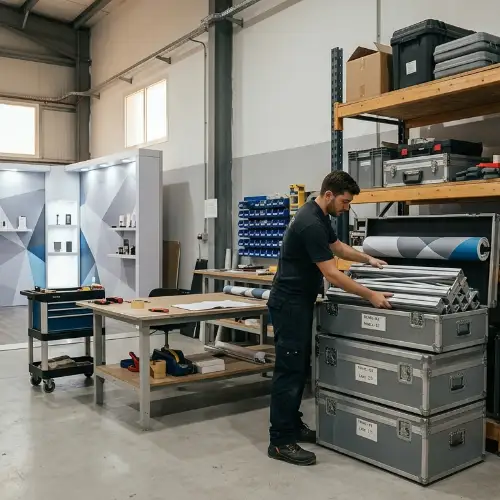
Plan storage early. A stand has to live somewhere between shows, so ask about crate size, total weight, and whether it breaks down into pieces small enough to move easily.
Test the size range. A system that builds both a small corner booth and a larger island from the same parts is more likely to stay in use than one tied to a single layout, because the same parts can follow the company from show to show.
Where UAE Policy Fits
The UAE Circular Economy Policy 2021 to 2031 sets a national direction toward keeping materials in use. It names four priority sectors, manufacturing, green infrastructure, sustainable transport, and food, and lists remanufacturing and reuse business models among the manufacturing focus areas. It is a national framework and does not set technical rules for exhibition stands, so venue and organizer requirements still decide what is allowed on the show floor.
Events have their own record here. In UFI’s 2020 Sustainable Development Award for waste management, ADNEC in Abu Dhabi was among the commended finalists for strong recent achievements.
What Reuse Cannot Fix
Reuse only pays off when a stand actually returns to the floor. A frame that sits in storage for three years has avoided nothing, and a one-time launch booth may call for a different approach. Count the events a stand will realistically attend before committing to it.
Environmental benefit also depends on materials, transport distance, and storage, so this article does not quote percentage savings. Anyone comparing options for a specific budget should ask suppliers for the material list and expected service life in writing and check organizer rules for the show in question.
Final Thoughts
Reuse in exhibitions is less about a special product and more about a planning habit: separate structure from message, pick materials that survive handling, and decide where the stand will wait between shows. Evet Advertising designs and manufactures exhibition stands in Dubai, with client coordination in Dubai and in-house production in Sharjah. Looking at the last booth you built, which parts could have gone to the next show?
FAQ
What actually makes an exhibition stand reusable?
Mostly the split between frame and graphics. If the structure is modular and the printed panels swap out, the same stand can come back with a new message. Quick setup and dismantling help too, because rough teardowns shorten a stand’s life.
How do I change the look without buying a new stand?
Swap the graphics and keep the frame. Printed panels or fabric can be customized for each event, and interchangeable display elements let you rearrange the layout. Before ordering, ask how the panels attach and how many swaps the fitting is built to handle.
Does reuse always cut waste?
Only when the stand really gets used again. UFI’s waste report calls stand the most pressing challenge in the industry, but a frame gathering dust in storage saves nothing. Count your likely events first, then ask about materials and expected service life.
Are there UAE rules on exhibition waste?
Check with the organizer and venue first. The UAE Circular Economy Policy 2021 to 2031 gives national direction on reuse and waste, but it is a framework, and UFI notes that waste regulations are not written specifically for exhibitions. Your exhibitor manual is the document to read.